The Contemporary Trial当代审判
Currently reading正在浏览Project overview项目概览
← All projects全部项目
03Curriculum Blueprint课程设计蓝图

The Contemporary Trial当代审判

A literature curriculum that places canonical texts on trial and moves students through understanding, judgment, and creative rewriting.将经典文本置于模拟法庭,通过理解、判断与改写,引导学生从“接受经典”走向公开论证与创造。

Role我的角色
Independent curriculum designer独立课程设计者
Learners目标学习者
Grade 10 students in a Shenzhen international school深圳国际学校高一学生
Format项目形式
Three-module curriculum + assessment system三模块课程+完整评估体系
Year / Status年份 / 阶段
2026 · Curriculum blueprint2026 · 课程设计蓝图
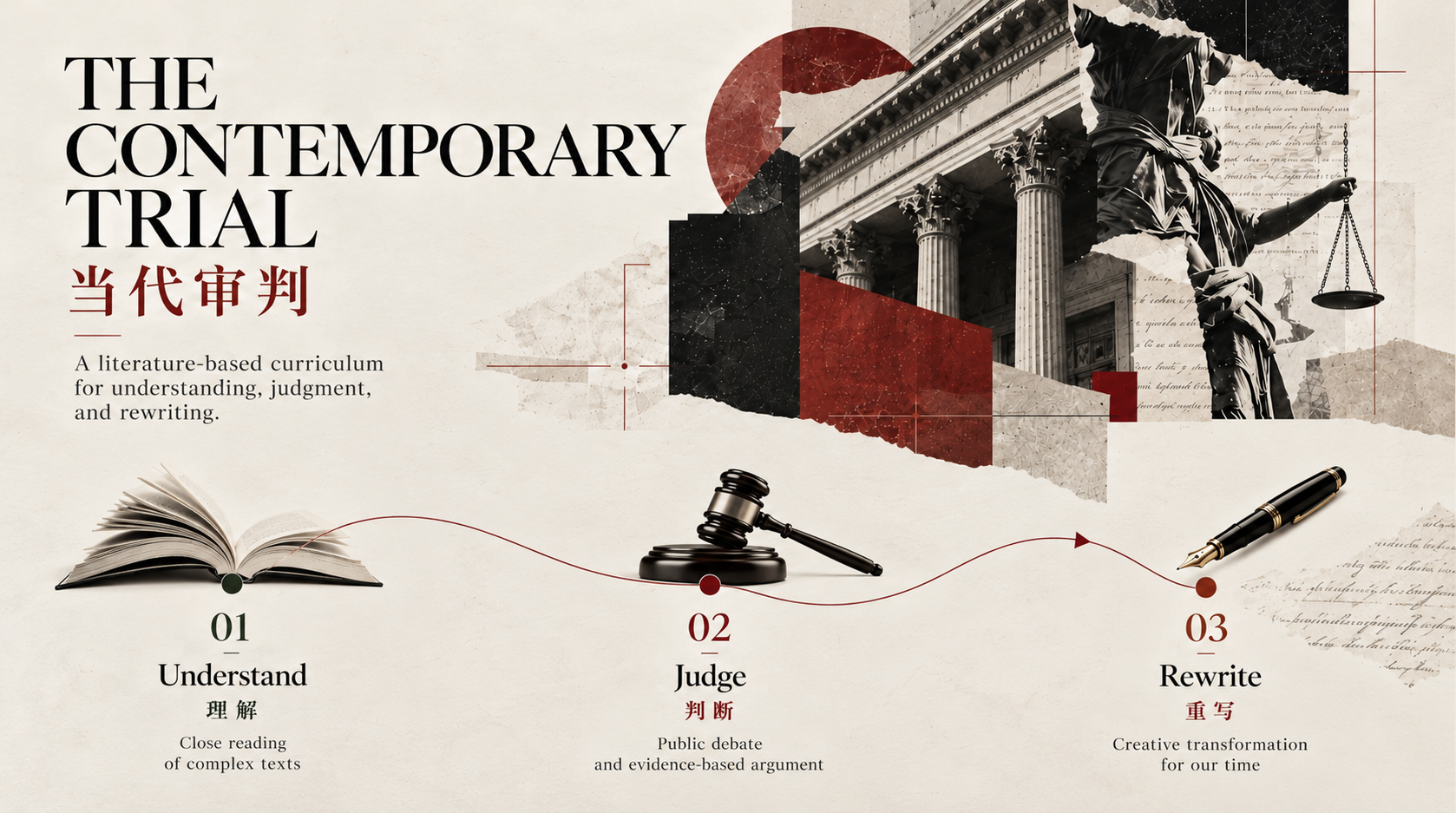
The Contemporary Trial cover: red-and-black courthouse collage, an open book, a gavel and a fountain pen for Understand, Judge and Rewrite.
Portfolio cover artwork · Open full size ↗作品集封面视觉 · 查看原图 ↗
Origin项目起点

Students knew why a text was called a classic before they knew whether they agreed.学生先学会了“为什么它是经典”,却还没有机会问“我是否认同”。

The curriculum grew out of my work on the Shenzhen Children’s Library’s “Twist on Classic” initiative. Across rehearsals, students could repeat the accepted reasons a work mattered, yet rarely had permission to examine whether those reasons convinced them. 这套课程源于我参与深圳市儿童图书馆“名著新编”短剧大赛时的观察。在排练中,学生很熟悉一部作品为何被称为经典,却很少被允许追问:这些理由是否真的说服了自己。

They had learned the answer, but not the question.他们学会了答案,却还没有学会提出问题。

The design responds to what I call performative literacy: performing respect for a text without developing a position toward it.项目回应的是一种“表演式阅读”:学生能够表现出对经典的尊重,却尚未形成自己与文本之间的立场。

The mock-trial structure turns questioning authority into a public, evidence-based action. Students must investigate a text, take a position, defend it under scrutiny, and then transform their judgment into an original rewrite. 模拟法庭把“质疑权威”变成需要公开承担的、以证据为基础的行动。学生先调查文本,再选择立场、接受质询,最终把判断转化为原创改写。

This is a complete curriculum blueprint designed for future implementation. It has not yet been taught as a full unit or evaluated with students. 这是一套为未来实施准备的完整课程蓝图,尚未以完整单元形式在真实班级中实施与评估。
Continue reading继续浏览02Learning arc学习路径
Learning arc学习路径

Understanding must precede judgment; judgment must lead to creation.理解先于判断,判断必须通向创造。

Module 1

Entering the Text进入文本

Students reconstruct historical, cultural, and rhetorical context and ask whose story is being told—and by whom.学生重建文本的历史、文化与修辞语境,并追问:这是谁的故事,又由谁来讲述。

  • Canon and cultural power
  • Narrative authority
  • Contextual reading
  • Excluded voices
  • 经典与文化权力
  • 叙事权威
  • 语境化阅读
  • 被排除的声音
Module 2

The Trial审判

Students construct and defend evidence-based arguments about whether a text deserves canonical authority.学生围绕一部作品是否配得上经典地位,构建并公开辩护以证据为基础的论点。

  • PEEL argument
  • Counterargument and rebuttal
  • Cross-examination
  • Fair judgment
  • PEEL论证结构
  • 反方观点与反驳
  • 交叉质询
  • 公平判断
Module 3

Rewriting the Canon改写经典

Students convert critique into authorship by changing a scene, relocating a conflict, or writing an ending the original did not offer.学生将批判转化为作者行动:改写场景、迁移冲突,或创造原作未曾提供的结局。

  • Creative transformation
  • Ethical positioning
  • Nuance and ambiguity
  • Reflective authorship
  • 创造性转化
  • 伦理立场
  • 复杂性与模糊性
  • 反思性创作
The Contemporary Trial original project artifact
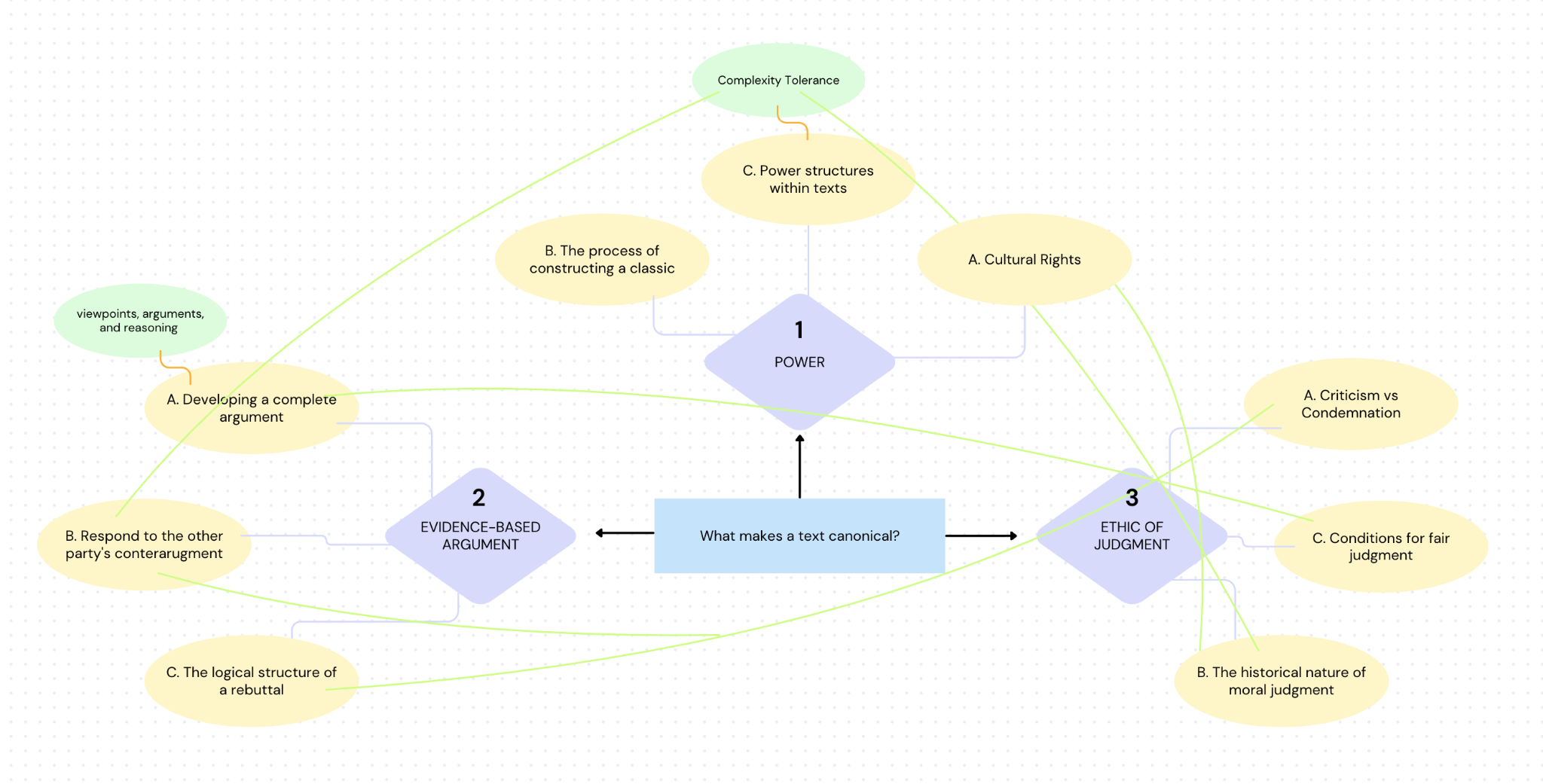
Original content map connecting power, argument, and the ethics of judgment.原创课程内容图,将权力、论证与判断伦理连接起来。
Continue reading继续浏览03Learning plan课程活动
Learning plan课程活动

A sequence that gradually increases intellectual and social risk.让思考与表达的风险逐步增加,而不是突然要求学生“大胆发言”。

Book Club Presentation书籍俱乐部分享

Students begin with a book they care about and examine who has—or has not—granted it canonical status.学生从自己真正喜欢的书出发,调查它由谁赋予或拒绝经典地位。

Through Text穿过文本看权力

Paired excerpts help students identify who narrates, whose perspective is centered, and whose voice is mediated or absent.通过配对文本,学生识别谁在叙述、谁被置于中心,以及谁的声音被转述或缺席。

Case Files人物与作者案卷

Role-play offers low-stakes practice in constructing arguments from an assigned standpoint.学生以指定人物或作者立场进行角色论证,在低风险情境中练习观点、证据与推理。

Waver立场光谱

Students physically position themselves from strongly agree to strongly disagree and may move when evidence changes their thinking.学生在“非常同意—非常不同意”的空间光谱上站位,并在被证据说服时公开移动。

Argument Workshop证据论证工作坊

Direct instruction introduces claim, evidence, reasoning, counterargument, and rebuttal before the public trial.在正式审判前,学生学习论点、证据、推理、反方观点与反驳的结构。

Trial: Arguments审判一:控辩论证

Prosecution and defense build cases, deliver opening statements, and face timed cross-examination.控辩双方共同构建案情、陈述开场意见,并进行严格计时的交叉质询。

Trial: Judgment审判二:陪审判断

Peer jurors co-create criteria for fair judgment, question attorneys, and justify a verdict in writing.学生陪审团共同制定公平判断标准,向控辩提问,并以书面证据说明裁决。

Nuance Rewrite复杂性改写与反思

Students return to their initial position, name unresolved tension, and transform critique into a creative response.学生回到最初立场,辨认仍未解决的张力,并将批判转化为创造性回应。

Assessment & hidden curriculum评估与隐性课程

The structure can reproduce the power it asks students to question.课程结构本身,也可能复制它试图批判的权力。

01

Evidence of learning学习证据

Book-club presentations, PEEL argument builders, case files, jury deliberation, written verdicts, and exit reflections are aligned to meaning, acquisition, and transfer goals.书籍分享、PEEL论证表、案卷、陪审讨论、书面裁决与退出反思,分别对应理解、能力习得与迁移目标。

02

Role allocation角色分配

If fluent English speakers repeatedly become attorneys while quieter students become jurors, the unit reproduces an existing hierarchy.如果英语更流利的学生总是担任律师,而内敛的学生总被安排为陪审员,课程便会复制既有等级。

03

What counts as “good argument”什么算“好的论证”

A rubric that rewards only linear, fluent English debate could quietly privilege one rhetorical tradition over indirect, narrative, or relational forms of reasoning.如果评估只奖励线性、流利的英语辩论,也可能无形中贬低间接、叙事性或关系导向的论证方式。

04

Safe friction有边界的摩擦

Class norms separate role from self, treat silence as thinking, and allow the teacher to pause the simulation when a sensitive issue exceeds the protective frame.课堂规范明确区分角色与自我,把沉默视为思考,并允许教师在敏感议题突破安全边界时暂停模拟。

Meaningful learning requires friction—but the friction must be designed, scaffolded, and ethically held.有意义的学习离不开摩擦,但摩擦必须被设计、被支撑,也被伦理地承接。
Continue reading继续浏览05Reflection项目反思
Reflection项目反思

Questioning a classic should not become another performance of correctness.质疑经典,也不能变成另一种“正确答案表演”。

The trial succeeds only if students can change their minds, sustain ambiguity, and distinguish criticism from total condemnation. A verdict is not the final learning outcome; the deeper outcome is the capacity to remain responsible to evidence while living with unresolved complexity. 模拟法庭只有在学生能够改变立场、承受模糊,并区分批评与彻底否定时才真正成立。裁决并不是最终学习成果,更重要的是:在问题尚未完全解决时,仍能对证据保持负责。

A future pilot should pay particular attention to role access, multilingual expression, emotional safety, and whether the assessment system recognizes more than one valid form of reasoning. 未来试教应重点观察:不同学生是否真正获得有分量的角色,中英双语表达如何被支持,情绪安全如何维持,以及评估是否承认不止一种有效的推理方式。